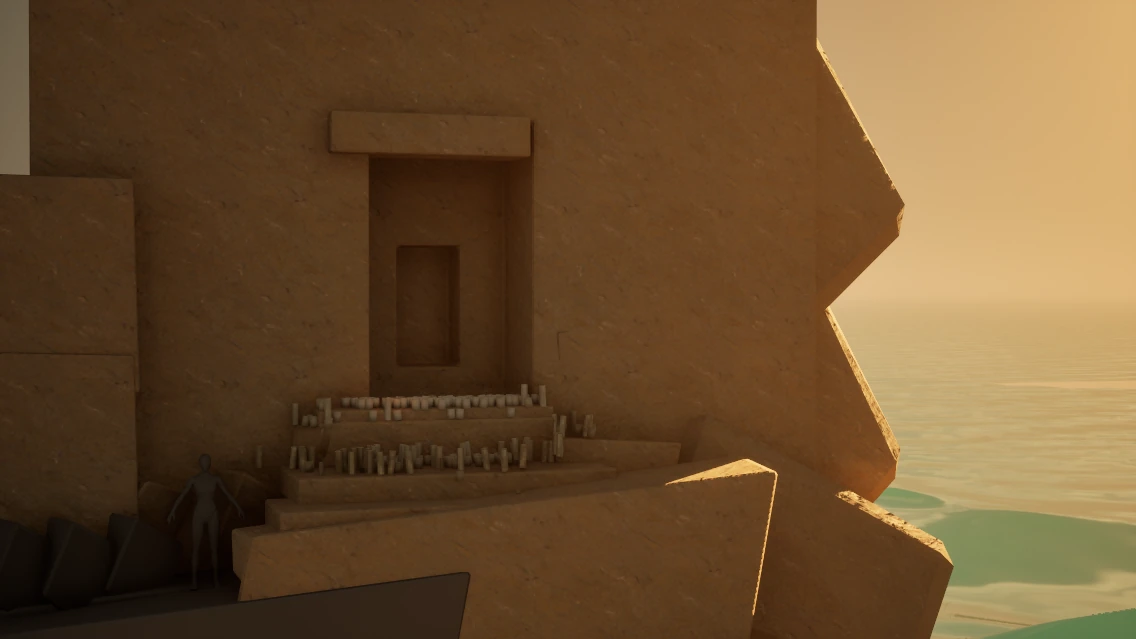
An environment with a specific idea
Salt Shrine began as a small Mediterranean coastal shrine: pale stone exposed to salt, sun and wind, with generations of offerings collecting inside it.
I used an age gradient to connect the composition and materials. New offerings would retain their colour near the edges; older ones would become bleached and fused into the accumulated centre.
I used AI assistance to try different compositions and develop the offerings and materials.
What I tried
Through Blender MCP, the agent built greybox variants and camera compositions, along with a candle-scattering experiment. The notes record ten composition variants. I compared them and selected a deeper niche with a wider shelf.
In Unreal, the work moved into PCG offering placement, an age-based distribution and materials for stone and wax. Per-point raycasts were added so the scatter could conform to the receiving geometry.
The image had the final say
The wax was still looking like opaque clay, even when the agent said subsurface scattering was working.
I checked the Subsurface Color view and found a black result. Further diagnosis traced this to the project’s Substrate configuration. A plausible explanation from the assistant had not been enough to establish that the effect was present. The candle video I recorded at that point showed the problem continuing; it was a bug report, not a finished material demonstration.
A separate PCG issue came from the difference between simple and complex collision tracing. Several earlier explanations were discarded before the actual mismatch was isolated.
Where I left it
Salt Shrine is paused. The blockouts, scatter and material tests are parts of an unfinished environment; the complete scene and final art pass remain open.